
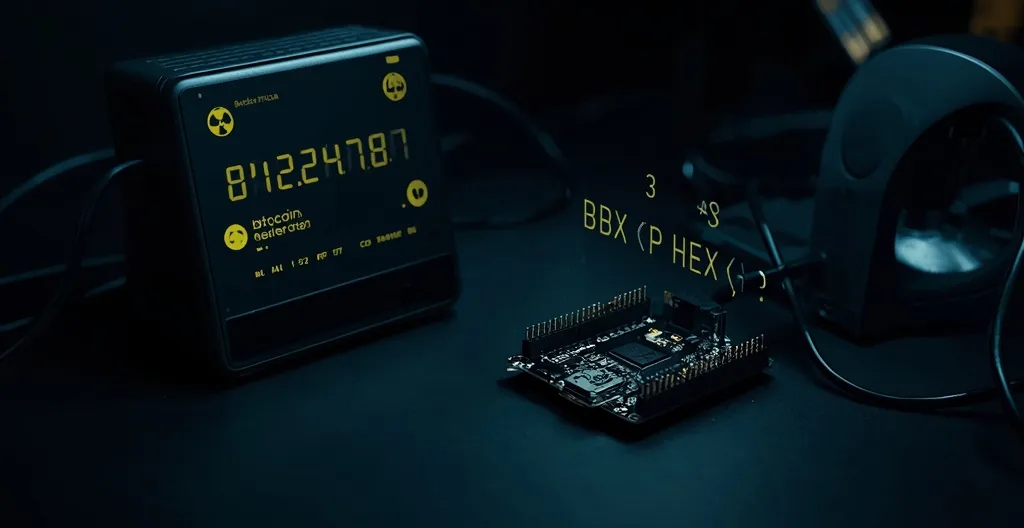
A Bitcoin seed phrase generated from radioactive decay is a wild idea, but Entropy32 Plus is real, open-source, and still very much a work in progress. Its creator says the entropy source has not been independently validated and should not be trusted with meaningful funds yet, which is the kind of blunt honesty crypto could use more often.
- Offline seed generation from Geiger-counter timing, not a browser or cloud service
- BIP39-compatible 12-word and 24-word recovery phrases
- No independent audit, no NIST SP 800-90B validation, and no public raw-event dataset
- Developer warning: do not use it for substantial funds yet
The project is called Entropy32 Plus, nicknamed “The Universe Bifurcator”, and it was published by developer Alexander Higgins in September 2026. The pitch is simple: use the timing of radioactive decay events detected by a Geiger counter to generate Bitcoin recovery phrases completely offline.
On paper, that sounds elegant. No Wi-Fi. No Bluetooth. No cloud entropy service pretending to be “secure” while phoning home to the digital goblins. Just a physical noise source, measured locally, turned into a wallet backup. That’s a lot more appealing than trusting a random website with your keys.
But the crypto graveyard is full of clever ideas that failed the only test that matters: can they actually protect money?
Entropy32 Plus uses a GQ Electronics GMC-320S Geiger counter connected through a 3.5-millimeter input, with an LM393 comparator and an ATmega328P microcontroller handling the signal path. The firmware records each accepted event with a microsecond timer, compares one interval to the previous one, and outputs a 1 if the new interval is longer or a 0 if it is shorter. Equal intervals are discarded, and anything under 200 microseconds is treated as a likely glitch and rejected.
That continues until 512 bits are collected. Those bits are then processed with SHA-256, which conditions and compresses the data before it is converted into a BIP39 recovery phrase. For 12-word mode, the first 16 bytes of the hash are used. For 24-word mode, the full 32 bytes are used, and then BIP39’s checksum and word-mapping rules do the rest. The Mnemonic Code for Generating Deterministic Keys is doing the heavy lifting here, whether people call it mnemonic magic or just good old-fashioned standards work.
That distinction matters. In BIP39, 12 words represent 128 bits of entropy plus a 4-bit checksum, producing a 132-bit sequence that is split into twelve 11-bit groups. A 24-word phrase uses 256 bits of entropy plus an 8-bit checksum, producing a 264-bit sequence that maps to 24 word indexes. The checksum helps catch mistakes when writing the phrase down. It does not make weak randomness strong. It does not bless bad entropy with magical Bitcoin sainthood. For a plain-English explainer, see BIP 39, or if you want the long-form version, The Complete Guide to BIP39 Mnemonic Seed Phrases lays out the mechanics without the usual hand-wavy nonsense.
BIP39 itself is just the standard that turns entropy into a human-readable mnemonic phrase. It uses a fixed list of 2, 048 words. That standardization is useful, but it is not a security guarantee. A phrase can look perfectly valid and still be compromised if the underlying randomness is biased, correlated, or predictable.
That is the real issue here. Collecting 512 bits of output data sounds impressive, but output size is not the same thing as entropy. The device may produce 512 comparison bits, but the project does not claim that each one contributes a full bit of true randomness. Without independent validation, that remains the unanswered question.
Higgins appears to understand the limitation. The repository says the entropy source has not been tested under NIST Special Publication 800-90B, a standard used to evaluate physical randomness sources and estimate whether they are actually unpredictable enough to trust. If you want the dry government version of that standard, it’s I'm sorry, but it seems like there is no HTML content, which is a very NIST way of saying “here be dragons.” Higgins also recommends mixing the Geiger-derived data with another independently validated source before using it for valuable funds.
“Please verify the entropy source you intend to use otherwise understand that you will be using the device at your own risk, ”
That is not marketing fluff. That is a warning label.
Higgins describes the project as an “experimental, educational project” and says users should not trust it with substantial funds before an independent review. That should be the headline, not the radioactive aesthetic. Plenty of crypto projects sell hype first and accountability never. This one at least admits it is not finished.
The design is intentionally offline. According to the repository, there is no Wi-Fi, no Bluetooth, and no persistent seed storage. The generated words live temporarily in RAM, and there is a manual wipe command. The firmware also runs a SHA-256 self-test at startup by hashing “abc” and checking the result against a known value. A nearby reference to New open-source device uses radioactive decay t underscores just how niche, and how oddly poetic, this hardware experiment is.
That self-test is useful, but only up to a point. It verifies the hash routine. It does not verify the Geiger counter, pulse independence, minimum entropy, or whether the hardware chain is behaving honestly. In other words, it checks that the math works, not that the randomness source is actually good.
And that’s the part people love to gloss over. Offline does reduce attack surface. It removes a bunch of obvious internet-based problems. But offline does not automatically mean secure. A device can be air-gapped and still be compromised by malicious firmware, tampered hardware, biased entropy, or supply-chain shenanigans. A box can look clean and still be lying to your face.
The lack of an outside audit matters for exactly that reason. As of Sept. 13, there was no published independent security assessment, no NIST evaluation, and no public raw-event dataset. Those are not minor footnotes. They are the difference between “interesting experiment” and “something I would use for real money.” If you want the social-media version of the same rabbit hole, there’s also BIP39 Seed phrase and the birthday paradox, which is what happens when people start treating seed math like it’s a vibes-based group project.
The hardware details also show how tight this build is. The BIP39 English wordlist alone takes up 13, 117 bytes, which is roughly 43% of the microcontroller’s flash capacity. The compiled firmware uses 30, 006 of 30, 720 bytes, leaving just 714 bytes unused.
That is a very small amount of breathing room. Security tools generally do not get points for being cramped and heroic. Tight flash usage does not automatically make the device bad, but it does suggest a prototype pushing hard against its limits rather than a polished production system with plenty of headroom.
There is also a subtle but important technical point buried in the design. The firmware does not simply count radiation pulses and call it a day. It compares the spacing between events. That kind of transformation can help reduce obvious patterns, but it also means the quality of the final output depends on the detector, timing thresholds, signal conditioning, and firmware logic, not just on the fact that radioactive decay is physically unpredictable.
Radioactive decay timing is a plausible source of entropy because the underlying events are not under human control. But real-world hardware is messy. Detector dead time, timing bias, signal glitches, and correlated measurements can all chip away at the randomness. The whole chain matters.
That is why hashing the output with SHA-256 is helpful but not magical. SHA-256 can condition and compress the data. It cannot manufacture entropy out of thin air. If the input is weak, the output can still be weak, just more neatly wrapped.
So the right way to read Entropy32 Plus is not as a ready-made cold-storage miracle, but as an experimental attempt to build a physical randomness source for wallet generation. That is genuinely interesting. It is also exactly the sort of thing that should be treated like a lab project until it survives independent scrutiny.
For Bitcoin users, the stakes are obvious. Wallets often derive many keys from one seed phrase. If the seed is weak, everything downstream is exposed. If the seed is solid, the whole system benefits from that one strong root of trust. That is why seed generation deserves more paranoia than most people bring to it.
Entropy32 Plus has the right instincts in some respects: it is offline, avoids networked entropy sources, and openly warns users not to overtrust it. But open-source transparency is not the same as cryptographic safety. The project still needs independent validation before anyone should treat it as a serious way to protect meaningful funds.
In a space full of fake certainty, that honesty stands out. The universe may bifurcate beautifully, but Bitcoin security does not care about vibes. And if you’re still wondering how seed phrases fit into the broader chaos of wallet hygiene, there’s a reason so many people keep circling back to the basics of BIP39 Mnemonic Seed Phrases, because the boring stuff is usually where the money either survives or gets bodied.
Key takeaways
-
Can radioactive decay help generate wallet keys?
In principle, yes. The timing of radioactive decay is a plausible physical entropy source, but the real question is whether the full hardware and firmware chain produces trustworthy randomness. -
Does offline generation automatically make a seed safe?
No. Offline design reduces network risk, but it does not prove the entropy source is strong, the hardware is honest, or the firmware is free from bias or tampering. -
Is Entropy32 Plus ready for large amounts of Bitcoin?
Not according to its own developer. Higgins explicitly warns that the entropy source has not been independently validated and should not be trusted with substantial funds yet. -
Does SHA-256 make weak randomness secure?
No. SHA-256 can condition and compress input data, but it cannot create entropy that was never there in the first place. -
What is the biggest unresolved issue?
Whether the Geiger-counter timing method actually produces enough independent, unpredictable entropy to justify using it for Bitcoin wallet generation in practice.
Further reading
One more angle on the radioactive-decay hardware angle, for anyone who likes their Bitcoin security with a side of mad-science.