
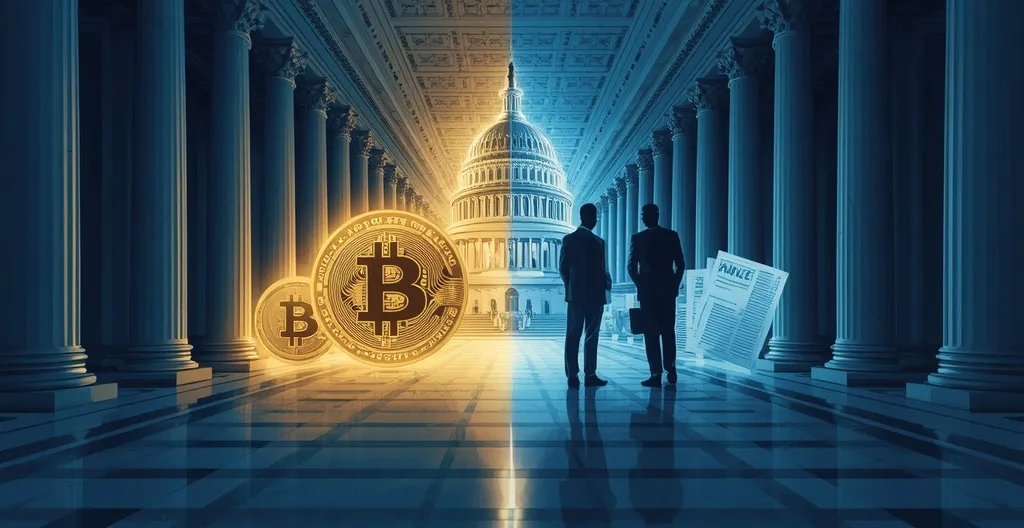
Tim Scott says the Senate will push the crypto market structure bill across the finish line
Senate Banking Chairman Tim Scott is backing the push to turn the [Digital Asset Market CLARITY Act](https://www.lummis.senate.gov/press-releases/lummis-releases-updated-clarity-act-text/) into real U.S. crypto law, joining Senator Cynthia Lummis and other lawmakers trying to answer the question Washington has dodged for years: who regulates what in digital assets?
- Scott backs the CLARITY Act push
- Lummis says the timing may be the best in years
- The fight is about SEC vs. CFTC jurisdiction
- Bitcoin, XRP, and other assets could all feel the impact
Scott said the goal is to “establish a legal crypto market structure for Americans, ” and he framed the effort as a way to protect everyday people, give entrepreneurs room to build, and support economic growth. Lummis, who has become one of the Senate’s most visible crypto advocates, said the coming weeks could represent the best opportunity in years for Congress to pass meaningful digital asset legislation.
That is not small talk. Market structure is the plumbing of the whole thing. If Congress gets it right, U.S. exchanges, custodians, token projects, and builders get a clearer set of rules instead of the usual bureaucratic knife fight dressed up as “guidance.” If Congress gets it wrong, we get another layer of legal fog with better branding.
What the CLARITY Act is actually trying to do
Market structure legislation aims to define which digital assets fall under the Securities and Exchange Commission and which belong under the Commodity Futures Trading Commission. That sounds dry until you realize it decides whether a token is treated more like a security, a commodity, or something in between.
That distinction matters for almost everything: exchange listings, custody, disclosures, secondary trading, and how much regulatory risk a company has to price in before it launches a product. In plain English, it tells businesses whether they are building under a rulebook or under a threat cloud.
The Senate effort is not being built in a vacuum. It reflects work from both the Senate Banking Committee and the Senate Agriculture Committee, which matters because crypto sits right on the line between securities and commodities policy. In Washington terms, that means overlapping turf, competing philosophies, and plenty of room for delay.
Scott praised Agriculture Committee Chairman John Boozman and Digital Assets Subcommittee Chair Cynthia Lummis for helping drive the effort. That matters because the bill’s path depends on lawmakers who understand that crypto does not fit neatly into old regulatory boxes. Bitcoin certainly does not. Many altcoins barely do either.
Scott said the measure would “protects everyday Americans and their hard-earned money” and “gives entrepreneurs a fair opportunity to seamlessly build and create jobs, thereby strengthening the economic growth of the country.” Lummis said the coming weeks could “represent the best opportunity in years for Congress to pass meaningful digital asset legislation.”
Those are the right instincts, even if Capitol Hill usually turns good instincts into a procedural swamp.
Why the bill matters for Bitcoin, XRP, and the rest of crypto
The biggest promise here is legal certainty. That phrase gets tossed around so often it can sound like marketing fluff, but it has real consequences. If an asset’s status is clear, companies can build around it without spending half their lives waiting for a lawsuit to explain the rules after the fact.
For Bitcoin, that could mean a framework that leaves decentralized ownership and self-custody alone while recognizing BTC as a commodity-style asset rather than a security-like instrument. That is the version many Bitcoiners want: clear rules, minimal meddling, and no attempt to shove a censorship-resistant network into a permissioned box.
For XRP and other major altcoins, the story is more complicated. A market-structure bill could give projects more predictability, but it could also separate stronger networks from weaker token setups, insider-heavy distributions, and outright garbage that has been hiding behind regulatory blur for years. Clarity cuts both ways. Some teams will welcome it. Others will find out the fog was the only thing keeping them upright.
There is also a practical angle for exchanges. Clearer classification rules could make listing decisions, custody policies, and compliance requirements less arbitrary. Right now, too many firms are forced to guess what a regulator might think after the fact. That is not a healthy way to build a financial system, unless your business model is paying lawyers to interpret vibes.
At the same time, the dark side of “clarity” is worth keeping in view. Congress can absolutely write a bill that looks pro-innovation on paper but ends up favoring large incumbents, creating loopholes, or preserving too much discretion for the same agencies that helped create the current mess. A bad framework would not be progress. It would just be regulated confusion with nicer stationery.
What is in the Senate draft
The Senate version is still a discussion draft, not final law. It builds on the House-passed CLARITY Act, but it is not identical to it. That distinction matters because the House and Senate still need to reconcile their versions before anything can become law.
According to the Senate Banking Committee, the updated text includes several concrete ideas:
- “Ancillary asset” definitions to help classify certain digital assets
- Tailored disclosure requirements for offers, sales, or distributions
- New SEC rulemaking ideas, including a proposed “Regulation DA” exemption concept
- Modernized securities rules for digital assets
- Illicit finance provisions and cooperation with law enforcement
For readers who are not steeped in committee jargon, “ancillary asset” is simply a legal category the draft uses to describe certain digital assets that may not fit traditional securities definitions. The point is to create a framework that is more precise than the current “we’ll know it when we sue it” approach.
“Regulation DA, ” as described in the Senate materials, is a proposed exemption concept rather than a finished, established rule. In other words, it is part of the drafting process, not a baked-in rulebook already sitting on the shelf.
The point of all this is not to make crypto more complicated. It is to stop pretending the same legal shoe fits every token, chain, and network. It doesn’t. Bitcoin is not a venture-style fundraising instrument. Some tokens are closer to commodities. Some are much closer to securities. Some are basically a spreadsheet with a mascot and a prayer.
Why the timing matters now
The legislative momentum is real, but it is still just momentum. The House passed the CLARITY Act on July 17 with bipartisan support, and the Senate Banking Committee later released an updated discussion draft on July 22 that builds on that work. That means there is a live path forward, but no finish line yet.
The Senate and House versions still have to be reconciled. That is where things get ugly. Not because the concept is impossible, but because Congress has a habit of turning straightforward policy questions into committee warfare and semantic trench battles. In crypto, those little wording fights determine who can build, who can list, who can custody, and who gets sued into the stone age.
Lummis’s urgency is not just political theater, either. If lawmakers miss this window, the next serious attempt could take years. That is exactly why industry groups, builders, and investors keep pushing for a framework instead of more enforcement-first chaos.
Scott’s backing gives the effort more weight because it shows the Banking Committee is not just tolerating the push; it is openly championing it. That does not guarantee success, but it does mean the Senate is treating crypto market structure as a real policy fight rather than a novelty for a hearing clip.
The real question behind the headlines
This is not really about one bill name or one press release. It is about whether the U.S. wants a crypto sector governed by clear rules or by selective enforcement and endless uncertainty.
The upside of getting this right is obvious: more confidence for builders, fewer gray areas for exchanges, better consumer protections, and a stronger case for keeping crypto innovation onshore. That is especially important for Bitcoin, which thrives when users can hold, move, and verify their own money without asking permission from a central gatekeeper.
The risk is just as obvious: if lawmakers write a sloppy bill, they could hand incumbents a moat, leave smaller projects stuck in the same regulatory swamp, and call it “progress.” That would be classic Washington nonsense. Lots of ceremony, very little substance.
For now, Scott and Lummis are signaling that they want the Senate to finish the job. Whether Congress can actually thread the needle between innovation, consumer protection, and agency turf wars is the part nobody should pretend is easy.
Key questions and takeaways
-
Is the CLARITY Act already law?
No. The House has passed a version, and the Senate is working from an updated discussion draft, but the bill still has a long way to go before it becomes law. -
Why does market structure matter so much?
Because it decides which agency oversees which parts of crypto. That affects exchanges, issuers, custody, disclosures, and whether companies can operate without constant legal guesswork. -
Does this help Bitcoin specifically?
It could, if the final language clearly distinguishes Bitcoin-like decentralized assets from securities-style tokens and leaves room for self-custody. That depends on the final text, not political promises. -
What about XRP and other altcoins?
They could benefit from clearer rules, but they may also face tighter classification tests. A real framework would separate stronger projects from weak or scammy ones instead of letting everything hide in regulatory fog. -
What is the biggest risk here?
Sloppy legislation. A bad “clarity” bill could create loopholes, lock in incumbents, or simply replace one mess with another.
Further reading
For the legislative backdrop and the competing drafts shaping U.S. crypto market structure, these are worth a look:
- U.S. Senate Banking Chairman promises to get the CLARITY bill across the finish line
- Scott, Lummis and colleagues release the digital asset market structure draft
- Strengthening American leadership in digital financial assets
- Senate Banking Committee advances the crypto market structure bill
- CLARITY Act faces a two-month Senate deadline as the fight escalates
- CLARITY Act faces June Senate deadline for U.S. crypto market structure reform
- Lummis warns the CLARITY Act must pass now or U.S. crypto rules could stall until 2030