
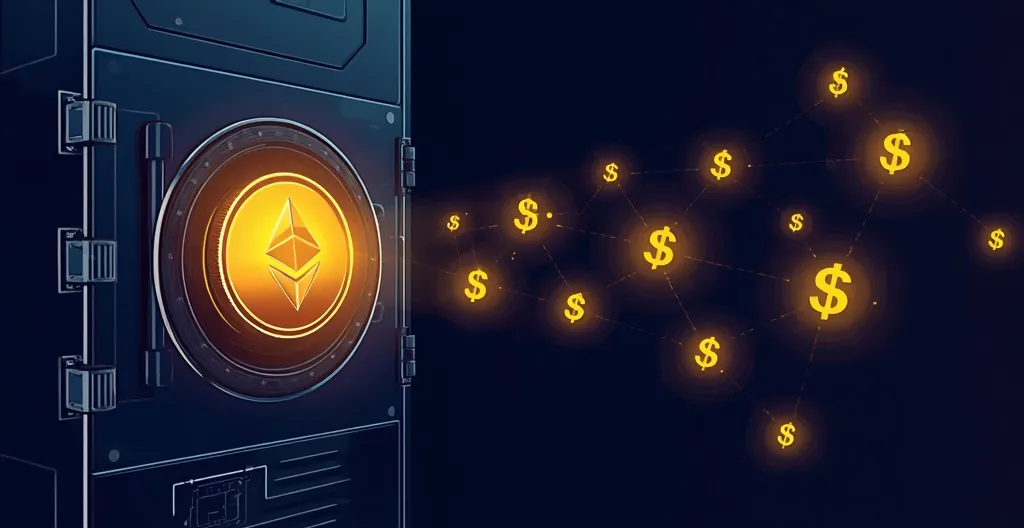
USDT0 is Tether’s omnichain dollar rail: a version of USDT designed to move across multiple blockchains without Tether deploying a fresh native contract on each one.
- Launched: January 2025
- Mechanic: USDT is locked on Ethereum, USDT0 is minted on destination chains
- Stack: LayerZero messaging, DVNs, and Everdawn Labs operations
- Core tension: marketed as “not wrapped, ” but it behaves like a canonical wrapper
That tension is the whole point. The label says one thing. The plumbing says another. And in crypto, plumbing is what matters when the pretty words stop working.
USDT0 is built on LayerZero’s Omnichain Fungible Token standard. In plain English, it is a token representation that can move between supported chains through verified cross-chain messages instead of relying on the old bridge model of pre-positioned liquidity on both sides.
The simplified flow is straightforward: native USDT sits in a smart contract vault on Ethereum mainnet. When a transfer is initiated, the corresponding amount is burned or otherwise removed from circulation on the source side, then a matching amount of USDT0 is minted one-to-one on the destination chain after the message is verified.
That makes USDT0 look cleaner than the usual bridge mess. It is also why the “not wrapped” branding deserves a raised eyebrow. A token backed by locked collateral and recreated elsewhere is not some mystical new category. It is a coordinated wrapper with better choreography.
Why it exists
The basic problem is simple: dollar demand does not stay politely inside one chain. Liquidity shows up where traders, apps, and payments need it, while issuers often have native deployments only on a handful of networks. That leaves users stuck with fragmented stablecoin supply, weird swap routes, or clunky bridge workarounds.
USDT0 is meant to reduce that friction. Instead of asking Tether to deploy everywhere or forcing users to juggle separate wrapped assets, it creates one standardized representation that can be moved across supported chains under a single system.
That is a real improvement over a lot of crypto bridge nonsense. It does not eliminate trust. It just removes some of the dumbest forms of friction and failure that have burned this industry before.
Why the label matters less than the mechanics
The “not wrapped” line is useful marketing, but it is not a technical escape hatch. If an asset is locked in one place and represented elsewhere through a controlled minting process, the economic shape is still wrapper-like, even if the branding is tidier.
That distinction matters because users should care less about the slogan and more about the trust model. Who controls the reserve? What verifies the message? Who operates the system? What happens if configuration drifts or a verifier setup changes?
Those are the real questions. Everything else is branding paint on top of infrastructure.
“The dollar stays in the vault. The claim on it goes everywhere.”
The trust stack is not trivial
USDT0’s reported trust model has several layers. First is Tether’s underlying USDT reserve. Then comes the Ethereum lockbox that holds the native collateral. Then there is LayerZero’s messaging and verification system. Then there is Everdawn Labs, which reportedly operates USDT0 under license rather than Tether running every moving piece directly.
That is a lot of moving parts for something marketed as simpler money.
LayerZero’s own documentation shows why this matters. Cross-chain pathways depend on explicit configuration on both sides, pinned libraries, DVN settings, and matching confirmation thresholds. DVNs, or Decentralized Verifier Networks, are independent parties that attest that a cross-chain message is valid. If the verifier setup or confirmation settings do not line up, messages can fail to verify or simply stop moving.
In other words: the system is not trustless in the Bitcoin sense. It is a managed coordination layer with clear operational assumptions. That may be good enough for many use cases. It is still not magic.
LayerZero also notes that verified messages can be executed permissionlessly once they exist, but that does not remove the need for application-level safety checks. Verification is one thing. Safe execution is another. Crypto loves to blur those together when convenient.
Why Stable made people pay attention
One of the strongest signs that USDT0 is more than a sidecar token is its use on Stable, a payments-focused chain. The reported setup says Stable’s v1.2.0 upgrade in February made USDT0 the chain’s native fee asset directly, and that simple USDT transfers on Stable are gas-exempt entirely.
That is significant because gas is not a cosmetic detail. Gas is the fee users pay to get transactions included on a blockchain. If USDT0 is the fee token, then it is not just moving through the chain. It is part of the chain’s economic plumbing.
For a payments network, that is the kind of integration stablecoins have been chasing for years. Not “look, a dollar token exists, ” but “the dollar token is the rail.” Big difference.
How big is it?
According to the reported figures, USDT0 had processed more than $50 billion in cumulative transfers by late 2025, with daily volumes running in the hundreds of millions. Those are serious numbers, but they need to be read with some skepticism.
On-chain volume is not the same as unique users or organic demand. It can include treasury movement, arbitrage, inventory cycling, and routing between venues. That does not make the numbers fake. It just means raw throughput is not a perfect proxy for real-world adoption.
The broader Tether ecosystem is much larger still. Tether’s total USDT circulation is described as $150-billion-plus across all chains, while USDT0’s locked collateral backing outstanding supply is said to be a single-digit percentage of total USDT. So USDT0 may be a small slice of the total supply picture, even if it is becoming a meaningful piece of infrastructure inside that picture.
Where it appears to be going
The reported deployments include Arbitrum, Berachain, HyperEVM, Flare, Ink, Unichain, Plasma, and Stable. That spread matters because it suggests USDT0 is not just being used on one isolated network, but is being positioned as a cross-chain stablecoin layer.
The system also reportedly supports XAUT0, the omnichain version of Tether Gold. That points to a broader model: if the reserve, messaging, and operator stack work for one asset, the same structure can be extended to others.
Tether is also described as the licensor and collateral issuer for USDT0, and as of February 2026, a strategic investor in LayerZero Labs. If that relationship holds, it shows how tightly stablecoin issuers and interoperability infrastructure are starting to align. Efficient? Sure. Purely decentralized? Not remotely. Real companies are still making the decisions.
Tether Launches USDT0 Standard: $1.3B Swap on Arbitrum to boost cross-chain transactions.
And that is where the decentralization purists start grinding their teeth. Fair. But there is also a practical case here: if a centralized issuer is already the dominant stablecoin supplier, a cleaner cross-chain system may be better than the current swamp of half-broken bridges and useless liquidity fragmentation.
What users should actually care about
For users, the practical appeal is obvious. A stablecoin that can move across chains without constant bridge gymnastics is useful. If USDT0 works as intended, it reduces fragmentation and gives apps a cleaner way to standardize dollar liquidity.
For skeptics, the real question is sharper: what exactly stands between the token you hold and the collateral vault? The answer is a stack of trust assumptions, not one magic protocol trick. Reserve backing, contract custody, LayerZero verification, DVN configuration, and operational control all matter.
That is the honest tradeoff. Better interoperability usually means more coordination, not less. Crypto maxis may hate that. Reality does not care.
Tether’s USDT0 on Kraken’s Ink: A Game-Changer for cross-chain transfers.
USDT0 is not the final form of cross-chain money. But it is a serious attempt to solve a real problem without relying on the brittle, undercollateralized bridge models that have already blown holes in this sector more times than anyone wants to count.
“Know which dollar you hold, and know the stack standing between it and the vault.”
Key questions and takeaways
-
Is USDT0 the same as native USDT?
No. Native USDT is the underlying collateral, while USDT0 is the omnichain representation used on supported chains. The claim on the dollar is backed by locked USDT on Ethereum. -
Is USDT0 really not wrapped?
Not in any meaningful technical sense. It uses lock-and-mint mechanics that look a lot like a canonical wrapper, even if the branding avoids that word. -
What makes USDT0 different from older bridges?
It relies on verified burn-and-mint messaging and a canonical collateral pool instead of liquidity sitting on both sides of a bridge. That reduces some bridge risk, but it introduces dependence on the messaging and verifier stack. -
Who operates it?
The reported setup says Everdawn Labs operates USDT0 under license, while Tether provides the underlying collateral relationship and LayerZero provides the cross-chain messaging layer. -
Why does Stable matter?
Stable using USDT0 as its native gas asset shows the token being embedded into chain economics, not just used as a transfer asset. That is a much stronger sign of utility. -
What is the biggest risk?
The biggest risk is the whole trust stack: reserve backing, contract custody, LayerZero verification, DVN configuration, and operational control. If any part is misconfigured or compromised, the system can stall or weaken on specific chains. -
Is USDT0 more decentralized than native USDT?
Not really. It is better described as a coordinated, issuer-aligned interoperability system. It may be more usable across chains, but it still depends on identifiable operators and verification infrastructure.
Tether’s $300M Celsius Deal and Paxos’s $300T Blunder
Tether Launches USDT0 Standard: $1.3B Swap on Arbitrum to boost cross-chain transactions.