
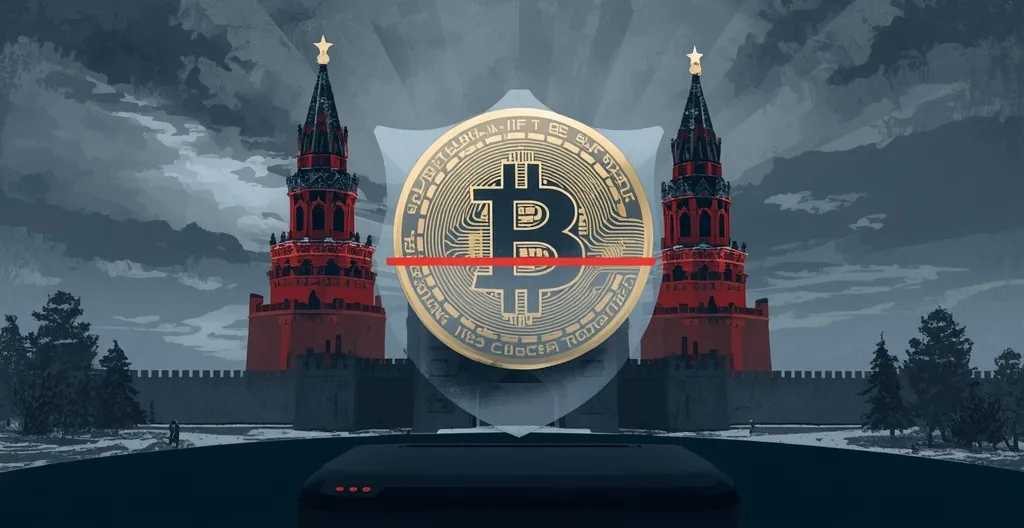
Russia is keeping crypto on a short leash. The state is willing to regulate it, tax it, and monitor it, but not let it replace the ruble at the checkout counter.
- Crypto can be regulated, not used as domestic money
- Russia’s framework favors oversight and reporting
- The state wants control, not a parallel payment system
The broad direction is clear, even if the exact parliamentary timing behind the headline is not fully pinned down by the available sourcing. Russia has long treated crypto as something that can exist inside a legal framework, as long as it does not start acting like an independent currency inside the country. Russian parliament passes law regulating crypto market I'm sorry, but the provided HTML content does not contain
That distinction matters. A crypto market is the ecosystem around buying, selling, holding, and servicing digital assets. Domestic payments are everyday transactions inside the country, paying for goods and services, moving money between people, and settling retail purchases. Russia’s position is basically: trade it, hold it, report it, but don’t spend it like money at home.
According to Russia and Cryptocurrency: Legal Framework and Regulations, that approach was codified in July 2020, when Vladimir Putin signed a regulation on digital financial asset transactions that legalized cryptocurrency transactions while explicitly prohibiting crypto from being used as payment for goods and services. In plain English: crypto was allowed into the regulated financial sandbox, but not onto the country’s payments rails.
Freeman Law also notes that Russian banks and exchanges can act as operators of digital financial assets if they register with the Bank of Russia, the country’s central bank and financial regulator. That means this is not a free-for-all. It is a permission structure, with the state deciding who gets to play and under what conditions. Bank of Russia Sets 2026 Deadline for Strict Crypto Rules Russia’s Central Bank Shifts to Crypto: Sanctions Escape or
Then there is the reporting side, which is where the “regulated” part gets a little less romantic and a lot more bureaucratic. Freeman Law says that starting January 1, 2021, Russian crypto holders with transactions exceeding 600, 000 rubles ($7, 757) in a calendar year were required to report crypto transactions and wallet balances to tax authorities. The same summary says the rule applies to both individuals and organizations, while government officials must declare crypto holdings and exchanges and miners must provide information to Rosfinmonitoring, Russia’s financial monitoring agency. Russia’s Ministry of Finance Advances Crypto Regulation
For readers who do not spend their weekends reading Russian compliance rules, Rosfinmonitoring is basically a financial intelligence and anti-money-laundering body. So when people say “Russia regulates crypto, ” that can mean a lot more than consumer protection. It can mean tracking flows, checking identities, and making sure the state can see where the money is moving.
That helps explain the logic behind the payment ban. Governments generally do not love private assets acting like a parallel currency inside their borders. It complicates tax collection, weakens monetary control, and creates a side channel for capital movement. From the state’s point of view, letting crypto exist as an asset is one thing. Letting it compete with the ruble as everyday money is a different beast entirely.
Crypto supporters will see the ban as a familiar compromise that dilutes one of Bitcoin’s core promises. Bitcoin was built as peer-to-peer money, not just another asset to be shuffled around on exchanges and reported to the tax man. If you can own it but cannot spend it domestically, the state has accepted the technology while bluntly rejecting the monetary challenge. That is not adoption with open arms. That is adoption with handcuffs.
Then again, a devil’s-advocate view is not crazy here. A government worried about money laundering, sanctions evasion, capital flight, or consumer confusion has a defensible case for keeping crypto out of retail payments. That does not make the policy elegant, but it does make it understandable. States like controls. Shocking behavior, truly. Error extracting content Russia's Use of Crypto Schemes
The important nuance is that Russia’s stance is not simply “crypto banned” or “crypto legalized.” It is narrower and more strategic than that. Crypto is tolerated as a regulated financial asset, but it is not allowed to become everyday domestic money. That is a long-standing Russian instinct, not a sudden policy conversion. Legality of cryptocurrency by country or territory
So the practical takeaway is straightforward: Russia appears to be tightening, formalizing, and supervising its crypto framework while keeping one hard red line in place, no domestic crypto payments. The state wants the market activity, the visibility, and the tax trail. What it does not want is a parallel monetary system growing under its nose.
Key questions and takeaways
-
Did Russia ban crypto completely?
No. The cited legal framework allows certain crypto activity, but it blocks crypto from being used as payment for goods and services inside Russia. -
Can Russians use crypto for everyday purchases?
Not under the framework described by Freeman Law. Crypto may be held, traded, and reported in regulated contexts, but domestic payments are prohibited. -
Is Russia regulating crypto or just restricting it?
Both. Russia’s system allows some crypto-related activity while requiring registration, reporting, and oversight through bodies like the Bank of Russia and Rosfinmonitoring. -
Why would a government allow crypto but ban payments?
Because it can capture the benefits of crypto activity, investment, innovation, and tax visibility, while preventing digital assets from competing with the national currency. -
What is the most important unresolved detail?
The supplied material does not fully verify the exact parliamentary timing or bill details behind the headline, so that part should be treated carefully.