
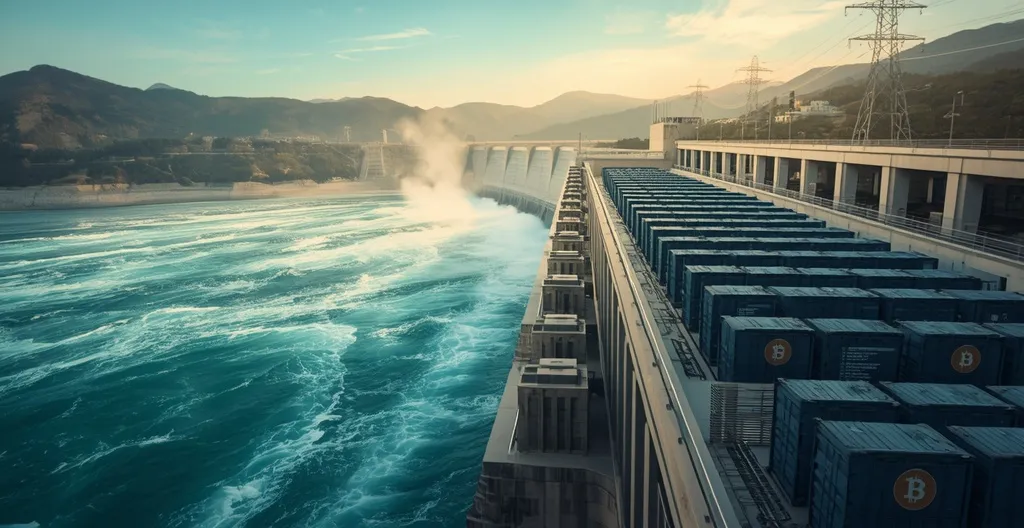
Hydropower overtakes gas as Bitcoin mining’s annualized power demand hits 190 TWh
Bitcoin mining is using more electricity than before, and Cambridge-linked research suggests the energy mix is getting cleaner even as total demand keeps rising.
- Annualized electricity demand: about 190 TWh in December 2025
- Up from: 138 TWh in June 2024, a 38% increase
- Low-carbon power: 59.4% of the reported mix
- Estimated emissions: about 48 million tonnes of CO₂e, up 20%
Preliminary research presented by Alexander Neumueller of the Cambridge Centre for Alternative Finance at the Energy Investors Forum in Dallas, and reported by theEnergyMag, suggests hydropower has overtaken natural gas as Bitcoin mining’s largest single energy source. Cambridge expects to publish a fuller second edition of its Digital Mining Industry Report later in 2026.
That combination is the part people keep trying to flatten into a slogan. It does not work that way. Bitcoin mining can shift toward lower-carbon power and still burn more total electricity. Both can be true at once, which is inconvenient for anyone who likes their talking points tidy and their reality obedient.
What changed in the latest estimates
Cambridge’s preliminary figures put Bitcoin’s annualized electricity demand at about 190 terawatt-hours in December 2025, up from 138 TWh in June 2024. That is a rise of roughly 52 TWh in annualized terms, or 38%.
Annualized electricity demand means the amount of power Bitcoin mining would use over a full year if the December 2025 rate continued. It does not mean miners actually consumed exactly 190 TWh during the 2025 calendar year.
On the supply side, the reported mix appears to have shifted. Cambridge says low-carbon power reached 59.4% of the mix, up from 52.4% in the previous study. In the 2025 Cambridge Digital Mining Industry Report, natural gas supplied 38.2% of surveyed miners’ electricity, renewables provided 42.6%, nuclear added 9.8%, and coal fell to 8.9% from 36.6% in the earlier 2022 estimate.
Hydropower overtaking natural gas is a meaningful headline. Coal’s drop is also real and worth acknowledging. That is a better outcome than the lazy caricature that Bitcoin is just coal with a marketing team. But a cleaner mix is not the same thing as a smaller footprint.
Why emissions still rose
Despite the cleaner reported mix, Cambridge’s preliminary estimate says greenhouse-gas emissions rose 20% to about 48 million tonnes of carbon-dioxide equivalent, up from roughly 40 million tonnes in the earlier survey-based estimate.
That is the basic tension here: Bitcoin mining can get cleaner on a percentage basis while still getting bigger in absolute terms. If the network expands faster than its power mix improves, total emissions can still climb. Efficiency gains do not magically cancel out growth. Physics is rude that way.
Cambridge’s own methodology matters a lot here. The estimate is based mainly on responses from mining companies representing slightly more than half of global Bitcoin hashrate. That is a substantial sample, but it is still not full coverage, and geography can skew the result if some regions respond more heavily than others.
The 2025 report said U.S. companies made up a large share of responses, which likely overstates the U.S. portion of global mining activity. That matters because power sources vary sharply by country. If one region is overweighted, the energy mix can tilt with it.
Why Cambridge’s emissions numbers do not line up neatly
Cambridge’s earlier survey-based estimate put emissions at 39.8 million tonnes. A separate location-based model came in much higher at 69.6 million tonnes. That gap is huge, and it is the part that should keep readers from treating any single emissions figure as holy writ.
A survey-based method estimates emissions from what miners say they use. A location-based model estimates emissions from where mining is believed to happen and what electricity grids those places rely on. The first can reflect miner behavior more directly. The second can produce a more conservative emissions estimate because it leans on grid-average assumptions and can be less forgiving about claims of cleaner power or special energy arrangements.
Neither method is perfect. One can undercount emissions if the sample is skewed. The other can overstate them if it assumes too much grid intensity. The real takeaway is not that one is fake and the other is truth. It is that Bitcoin mining emissions are still model-sensitive, and that uncertainty is part of the debate, not a bug.
Cambridge’s Bitcoin Electricity Consumption Index remains one of the most closely watched tools for estimating Bitcoin’s power use, but it is still a model, not a meter. That distinction matters. Estimation is useful. Pretending estimation is certainty is how people end up doing propaganda with spreadsheets.
Hydropower may be rising for two reasons at once
The hydropower result may reflect a real shift in mining energy sourcing. It may also reflect better survey coverage in hydro-heavy regions. Most likely, it is some mix of both.
Ethiopia is one example to watch. The notes point to a hydro-rich market where coverage may have improved, helped by cheap electricity linked to the Grand Ethiopian Renaissance Dam. If Cambridge is now capturing more mining activity in places like that, hydropower’s share would rise even if the global picture had not changed quite as dramatically as it first appears.
That does not make the finding worthless. It just means readers should avoid turning one data point into a grand victory lap or a smug dismissal. Better coverage is still better coverage, but it is not the same thing as a complete global map.
The AI and HPC pivot is real, but still early
The other important thread in the Cambridge findings is the growing interest in AI and HPC, or high-performance computing. These are compute-heavy workloads that can give mining sites a second life as data and infrastructure hubs instead of leaving them stuck doing one volatile job forever.
About 10% of respondents said they had already allocated some power to AI or accelerated computing. More than 40% of the other respondents said they were actively exploring it. Almost nine in ten expected AI and HPC diversification to gain ground over the next several years.
That sounds big, and it may well become important. But there is a long way between “we’re looking at it” and “we’ve actually converted the site, signed the contracts, and made the economics work.” Alexander Neumueller summed it up neatly: “intent to look into it is not commitment to deploy.”
That line is doing a lot of work, because miners love a diversification narrative when Bitcoin margins are under pressure. The reality is messier. AI and HPC demand different cooling, networking, reliability, and often different financing structures. A mining shed with power lines attached is not automatically a data center. The upgrades can be expensive, and not every site is remotely suitable.
Still, the shift is not imaginary. According to a cited crypto.news report, listed miners have announced more than $70 billion in AI and HPC contracts. TeraWulf is a concrete example of where this can go: in the first quarter of 2026, it generated $21 million from HPC services and less than $13 million from digital asset mining.
That does not mean Bitcoin mining is being replaced. It means some operators are realizing that power, land, cooling, and grid access can be sold to higher-value compute customers too. In other words: if the Bitcoin-only model is volatile and ugly, the AI side hustle starts looking a lot less crazy.
What the numbers do and do not prove
The new figures point in the same direction as a growing body of mining research: Bitcoin is still energy-hungry, but its reported power mix is not frozen in coal-and-gas amber. The coal share has fallen sharply from earlier estimates, hydropower now appears to lead the pack, and some miners are clearly trying to monetize infrastructure beyond Bitcoin block rewards.
At the same time, none of this means the network has become magically low-impact. Annualized demand is still rising. Emissions are still rising. And the gap between survey-based and location-based emissions estimates is still wide enough to drive a freight train through.
So the honest reading is this: Bitcoin mining is getting more sophisticated, more geographically diverse, and in some cases more economically flexible. It is also still consuming a huge amount of power to secure a monetary network that nobody can print at will. Whether that tradeoff is worth it depends on how you think about money, energy, and the value of an open monetary system.
Related energy and mining angles
Bitcoin’s energy debate does not stop at Cambridge’s estimates. Broader industry reporting has tracked how the power mix shifts over time, including Bitcoin Mining's Energy Mix in 2026: Renewables, Stranded and the continuing argument over whether the network is becoming more efficient or just better at telling a cleaner story.
That debate is not just academic. Researchers and policy analysts have spent years trying to quantify the footprint through projects like Bitcoin Mining: Energy Integration and Strategic Policy, while critics often point to broader concerns captured in the long-running discussion around the Environmental impact of bitcoin.
For a more grounded look at how mining can interact with local power systems, the case of Gridless Turns Zambia’s Excess Hydropower into Bitcoin shows the upside when stranded or surplus electricity gets monetized instead of wasted. That model is not a silver bullet, but it is a lot more interesting than hand-waving about “wasted energy” without understanding grid economics.
There are also examples where mining has been pitched as an industrial rescue mission for electricity-intensive assets, such as Alcoa to Sell New York Smelter to NYDIG for Green Bitcoin. Whether you see that as resourceful reuse or financial cosplay depends on how much faith you have in markets to allocate stranded infrastructure better than bureaucrats do.
And if you want the deep background on how power demand itself has shifted, research such as Bitcoin electricity consumption: an improved assessment has helped shape the methodology debate that keeps making headline numbers look more confident than they really are.
Key questions and takeaways
-
Did Bitcoin mining’s electricity demand really jump to 190 TWh?
Cambridge’s preliminary estimate says annualized demand reached about 190 TWh in December 2025, up from 138 TWh in June 2024. That is a run-rate estimate, not a direct count of what miners consumed over the full calendar year. -
Does a cleaner energy mix mean Bitcoin mining is now “green”?
No. Low-carbon power rose to 59.4% of the reported mix, but estimated emissions still increased to about 48 million tonnes of CO₂e because total demand also climbed. -
Why do Bitcoin mining emissions estimates vary so much?
Because the methodology changes the answer. Cambridge’s survey-based estimate and location-based model produced very different results, with earlier figures of 39.8 million tonnes and 69.6 million tonnes respectively. -
Is hydropower now the biggest mining energy source?
Cambridge’s preliminary findings suggest yes, with hydropower overtaking natural gas as the largest single source. But survey coverage in hydro-heavy regions may also be affecting the result. -
Are miners really moving into AI and HPC?
Some are, but it is still early. Only about 10% of respondents had already allocated power to AI or accelerated computing, while more than 40% of the rest were exploring it. -
Which mining company is already showing the HPC pivot in numbers?
TeraWulf Inc. Q1 2026 Financial Results: Net Loss and show a real shift, with HPC services contributing more than digital asset mining in the quarter. -
What does this mean for Bitcoin’s long-term energy debate?
Bitcoin is still power-hungry, but the mix is changing. The real question is whether mining keeps evolving into a flexible infrastructure business or stays trapped in the old “just burn electricity for hashes” caricature.
Further reading
For a deeper look at the methodology behind Bitcoin’s power-use estimates, this Cambridge paper is worth your time: