
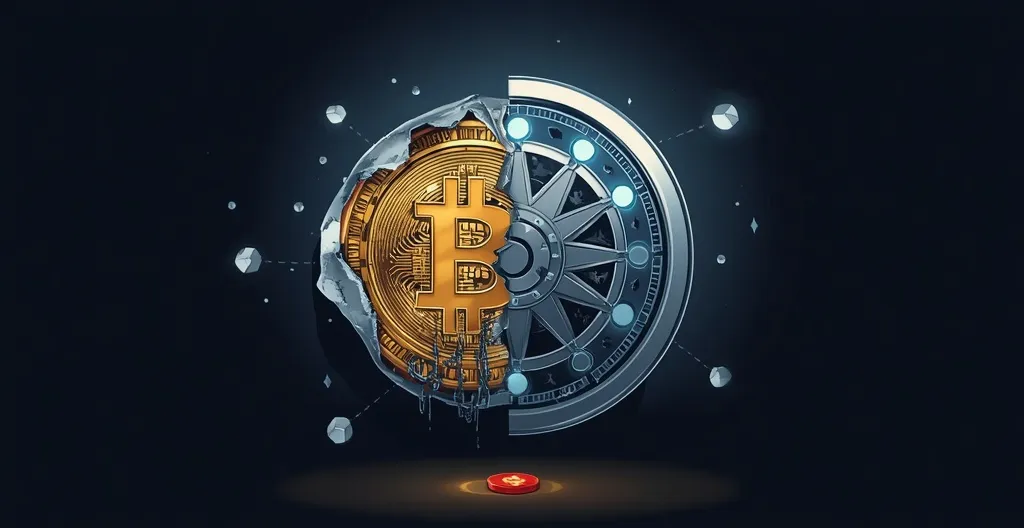
Cardano Price News: Hoskinson Says Bitcoin’s Frozen Governance Is Its Biggest Vulnerability
Cardano is still struggling to gain traction, but Charles Hoskinson’s bigger jab landed squarely on Bitcoin: in his view, the network’s real weakness is not quantum computing itself, but a governance model that is too rigid to respond quickly if a serious upgrade is needed.
- ADA remains weak: price action is still bearish unless it reclaims $0.20.
- Hoskinson’s point: Bitcoin’s governance is too hard to change when it matters most.
- Cardano’s pitch: on-chain voting is meant to make upgrades easier to coordinate.
- Technical view: ADA may be stabilizing, but that is not the same as bottoming.
The broader crypto market has been under pressure, with Bitcoin also slipping lower. That kind of weakness tends to hit altcoins harder, and Cardano has not been spared. ADA was trading just above $0.16 in the market snapshot referenced by the source, while Bitcoin was near $64, 000.
The more interesting fight, though, is not about a daily candle. It is about whether Bitcoin’s refusal to move fast is a feature, a flaw, or both.
Hoskinson’s criticism: Bitcoin can be too slow to protect itself
Hoskinson described Bitcoin’s governance as “frozen in time” and said that is its biggest vulnerability. His argument is straightforward: Bitcoin’s upgrade process depends on broad social agreement, miner and node coordination, and a culture that treats major protocol changes like radioactive material.
That caution has kept Bitcoin stable, conservative, and hard to capture. It has also made it notoriously difficult to change, as anyone who has ever tried to explain Bitcoin forks explained: hard forks, soft forks & why can attest.
Hoskinson’s warning is tied to the long-term quantum computing debate. The concern is not that a quantum machine is about to wreck Bitcoin tomorrow morning. The concern is that if Bitcoin ever needs a major cryptographic upgrade, its governance structure could make that response painfully slow, messy, and politically toxic.
That is a real tradeoff. Bitcoin’s ossification protects it from reckless meddling. It also means the network may move like a glacier when it needs to move like an emergency response team.
And no, quantum computing is not about to vaporize Bitcoin next Tuesday. This is a future risk discussion, not a panic button. Anyone trying to sell instant doom is doing the usual crypto theater routine.
“Bitcoin’s governance” in this context means how the network agrees on changes. Unlike a company, Bitcoin has no CEO who can just push a button and force an upgrade through.
For those tracking the technical side of this debate, the relevant field is post-quantum cryptography, which focuses on encryption methods designed to resist attacks from future quantum computers.
Why Cardano keeps leaning into the governance angle
Cardano has long marketed itself as a more formal, research-driven network with governance built into the protocol. The idea behind on-chain voting is simple: stakeholders can coordinate decisions directly on the blockchain instead of relying mostly on off-chain social consensus, developer signaling, and informal pressure campaigns.
Hoskinson frames that as an advantage. If a network can vote upgrades into place, it may be able to react more cleanly to future threats and technical changes.
That is the theory. The practice still has to be proven.
Cardano’s governance model may be more structured than Bitcoin’s, but that does not automatically make it better in every case. More formal governance can also mean more complexity, more bureaucracy, and more opportunities for politics to sneak in wearing a nice protocol-shaped suit.
Hoskinson also said Cardano’s upcoming upgrade is designed to make the network 60 times faster. That is a big claim, and big claims in crypto should always be treated with caution until they show up in live network performance. Speed promises are easy. Delivery is the part that separates engineering from marketing.
That said, Cardano’s supporters will point to the broader roadmap and the chain’s long-running push toward scalability, including periods where Cardano price consolidates before potential wave 3 explosion has been a recurring bullish setup in trader circles. Whether that optimism ages well is, as always, another matter entirely.
Hoskinson has not exactly been shy about selling the larger vision either. He has previously said Cardano is ready to “take over the world”, which is the kind of line that sounds either visionary or wildly overcaffeinated depending on whether the chart is green or red that day.
ADA price action: stabilizing, not healed
On the chart, ADA still looks fragile. More Crypto Online said Cardano is stabilizing around $0.163, which is being watched as the first major downside target and the 78.6% Fibonacci retracement level. In plain English, Fibonacci levels are common chart markers traders use to identify possible support or resistance. They are widely watched, but they are not magic.
The important distinction here is that stabilizing is not the same as bottoming. A coin can stop falling for a while without actually reversing. Markets do that all the time. They pause, tease, and then decide whether to keep grinding lower or force a bounce.
As long as ADA stays below $0.20, the bearish wave structure remains intact. A reclaim of that level would make a rebound toward $0.23 and $0.314 more credible. Until then, the path of least resistance remains lower.
The next major downside level sits at $0.092, which is described as the 100% Fibonacci extension level. That would be a brutal move from current levels, and a reminder that many altcoins are still living in the long shadow of the 2021 cycle, when ADA traded above $3.00.
The likely near-term range is $0.16 to $0.18. That is not exactly a thrilling setup. It is the kind of range that makes traders stare at the screen like the chart owes them money.
And if you want the blunt version: when a project is under pressure, the market rarely rewards speeches. It rewards execution. Hoskinson’s past run-ins with the market have also kept plenty of people skeptical, especially after the kind of fraud allegations against founder Charles Hoskinson that can poison trust faster than a bad token unlock.
There is also a reason ADA price chatter often gets dragged back to bigger structural debates around leadership and credibility, including the fallout from Charles Hoskinson’s $2.5B loss and the more recent effort to reset the public narrative around his role in the ecosystem, as seen in Charles Hoskinson’s 2026 Cardano reset.
What Bitcoiners would say back
To be fair, Bitcoin’s defenders would argue that rigidity is the point. A network that changes too easily becomes a network that can be captured too easily. The same governance friction Hoskinson criticizes is also what keeps Bitcoin resistant to opportunistic rule changes, political games, and the endless parade of “trust us, this fork is different.”
That is why this debate matters. Bitcoin’s conservatism is both its moat and its possible Achilles’ heel. Cardano’s pitch is that a more formal governance structure can reduce chaos without sacrificing decentralization. Bitcoin’s answer is that too much governance can become a backdoor for the very mess decentralization was supposed to avoid.
Both sides have a point. That is the annoying thing about serious protocol design. The tradeoffs are real, and the slogans are always too neat.
Key takeaways
-
Why is Hoskinson criticizing Bitcoin?
He says Bitcoin’s biggest weakness is its governance model, which is slow and rigid when major changes are needed. In his view, that matters more than the quantum threat itself. -
Is quantum computing an immediate danger to Bitcoin?
No. The discussion is about a long-term security issue, not a near-term collapse. The real question is whether Bitcoin can coordinate a future response without breaking its own culture. -
What is Cardano’s governance pitch?
Cardano argues that on-chain voting can make upgrades easier to organize and execute. That does not prove it is better in practice, but it is the core contrast Hoskinson is pushing. -
Is ADA bottoming at $0.163?
Not confirmed. More Crypto Online says ADA is stabilizing near that level, but stabilizing is not the same as bottoming. The chart stays bearish unless ADA reclaims $0.20. -
What happens if ADA loses $0.163?
The next major downside level is $0.092, which the technical setup identifies as the 100% Fibonacci extension target. That would signal more downside pressure, not a clean reversal. -
What would improve the short-term outlook?
ADA would need to break back above $0.20 and hold it. That would make a move toward $0.23 and $0.314 more believable and weaken the bearish wave structure.
The deeper takeaway is simple. Bitcoin’s rigidity is part of what makes it Bitcoin, but it may also make future upgrades harder than the market likes to admit. Cardano’s governance model is trying to prove that a blockchain can be more adaptable without turning into a centralized clown show.
ADA’s price action still has work to do, and the fundamentals alone are not getting much love from the market right now. That may change if Cardano delivers on its upgrade promises. Until then, the chart is the chart, and the market is not obligated to care about anyone’s narrative.
Further reading
A bit more context on Bitcoin’s upgrade politics and the quantum debate.