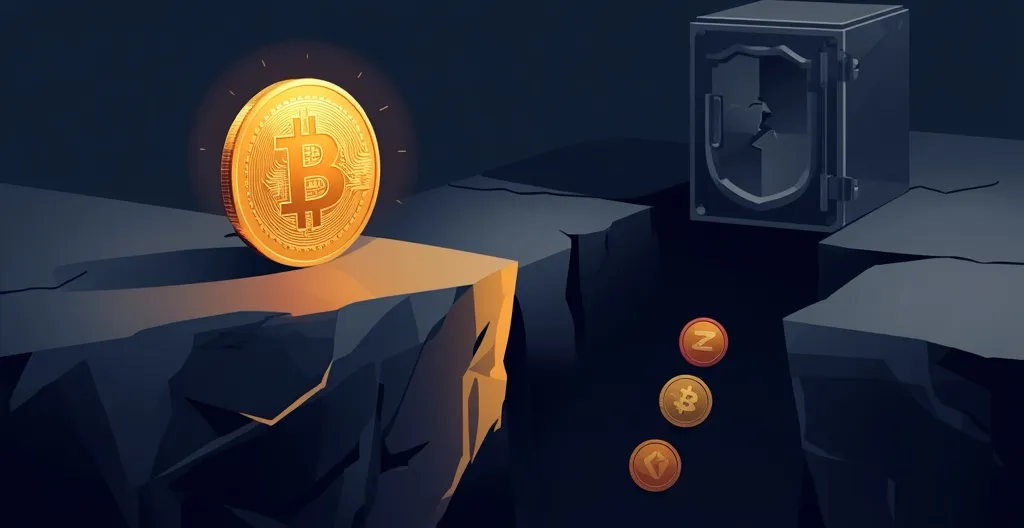

Garden Finance paused its app after an independent solver’s off-chain database was compromised. It is a neat reminder that crypto can look fine on-chain while the messy operational layer is already on fire.
- App taken offline after a solver-side security incident
- Garden says protocol contracts and user funds were not compromised
- Blockaid estimated about $450, 000 in USDT was drained
- Outside security firms brought in to trace funds and support recovery
Garden Finance temporarily shut down its application after a security incident involving one of its independent solvers, not a breach of the protocol’s core smart contracts. The company says the compromise hit an off-chain database controlled by that solver, which led to fraudulent transaction records and unauthorized fund releases from HTLC-based swaps.
That difference matters. A protocol-level exploit means the on-chain logic failed. A solver-side compromise means the plumbing failed. The second one can still be expensive, messy, and damaging, it just does not mean the underlying contracts were cracked open like a cheap lock.
Garden told Cointelegraph that “Garden’s protocol and HTLC smart contracts were not compromised, and no user funds were lost or at risk, ” while stressing that the affected assets belonged to the solver, not the protocol. Garden also said it is still verifying the total amount lost, plus the exact assets and networks involved.
HTLCs, or hash time-locked contracts, are escrow-like smart contracts used in atomic swaps. Atomic swaps let two parties exchange assets across chains directly, without a centralized intermediary, by using contract rules that make both sides of the trade complete together or fail together. Clean theory. Ugly reality when the off-chain operator gets compromised.
According to blockchain security firm Blockaid, about $450, 000 in USDT was drained from HTLC contracts across Ethereum, Base, Arbitrum, and BNB Smart Chain. Blockaid said the attacker inserted fraudulent transaction records into the compromised solver database, which caused funds to be released for swaps that had never been funded by the counterparty.
That is the core of it: fake records convinced the system a swap had been funded when it had not, and the contract logic did the rest. Smart contracts are deterministic. If the inputs are manipulated upstream, the on-chain result can still be disastrous.
Garden has not yet confirmed Blockaid’s estimate as the final loss figure, and that nuance matters. Early security estimates are useful, but they are still estimates. Investigators often need time to separate the real loss from the initial noise, trace wallet movement, and determine which funds were actually affected.
The protocol said it has engaged zeroShadow, Quantstamp, and Blockaid to trace stolen assets and support recovery efforts. Garden also said it expects to restore normal services after additional security reviews, but it has not given a timeline.
Garden pointed to its recently completed SOC 2 Type II attestation. That is a meaningful control assessment: it shows operational controls were tested over time, not just claimed in a marketing deck. But it is not a force field. Certifications can strengthen trust, but they do not stop attackers from targeting off-chain databases, access controls, or other weak points outside the contract code.
The bigger lesson here is one crypto keeps relearning the hard way: decentralization reduces reliance on a single gatekeeper, but it does not erase operational risk. If a system depends on independent solvers, off-chain records, and other human-run infrastructure, then the weakest operator can still become the attack path. The blockchain may be the fortress wall. The back office is often the side door left propped open.
The source also notes a similar Garden Finance takes app offline after independent solver breach in October 2025 that reportedly led to about $11.4 million in losses. Separate recent disclosures from Lien Finance and Triple-A point in the same direction: a lot of crypto damage still comes from operational failures, not from elegant code-level wizardry.
That does not mean the industry should throw up its hands and go back to TradFi’s bloated middlemen and permissioned nonsense. It does mean people need to stop pretending decentralization automatically eliminates trust assumptions. It does not. It changes them.
For Garden users, the immediate reality is simple: the app is offline while the company reviews the incident and verifies the impact. For everyone else watching cross-chain systems mature, this is another blunt reminder that good smart contracts are only part of the story. If the off-chain machinery is sloppy, the whole setup can still bleed.
Outside security coverage also pointed to Garden Finance disables app as Blockaid reports $450, 000, while another report framed the same incident as Garden Finance disables app as Blockaid reports $450, 000 exploit. If you want to understand the mechanics, those writeups line up with the broader picture: bad operator security, not broken math.
Key takeaways
-
Was Garden Finance’s protocol hacked?
Garden says no. It says the compromise was limited to one independent solver’s off-chain database, while the protocol’s smart contracts were not compromised. -
Were user funds affected?
Garden says no user funds were lost or at risk. The company says the losses were tied to solver-owned assets. -
How much was drained?
Blockaid estimated about $450, 000 in USDT was drained, but Garden says it is still verifying the final total. -
Which networks were involved?
Blockaid said the HTLC contracts were deployed across Ethereum, Base, Arbitrum, and BNB Smart Chain. -
Why did Garden take the app offline?
It paused services to contain the incident, review security, and work with outside firms on tracing and recovery. -
Did Garden bring in outside help?
Yes. Garden said it engaged zeroShadow, Quantstamp, and Blockaid. -
Why does this matter beyond Garden?
Because it shows how off-chain infrastructure can still sink a system even when the on-chain contracts are intact. Crypto security is only as strong as the weakest operator in the chain.
One more ugly truth: even as infrastructure gets tighter, the outside world keeps pressing in. MiCA Forces USDT Squeeze in Europe as USDC Gains Ground shows how regulation can reshape stablecoin usage, while Russia Targets USDT, USDC and BNB With New Crypto Fees and Limits is another reminder that governments are still very interested in putting their grubby hands on crypto rails.
And because crypto never lacks for geopolitical theater, US Treasury Seizes Nearly $1 Billion in Iran-Linked Crypto underscores how centralized choke points, especially stablecoin issuers, can become enforcement tools overnight. That may be useful for sanctions; it also means “decentralized finance” still runs through a lot of very centralized plumbing. Funny how that works.