
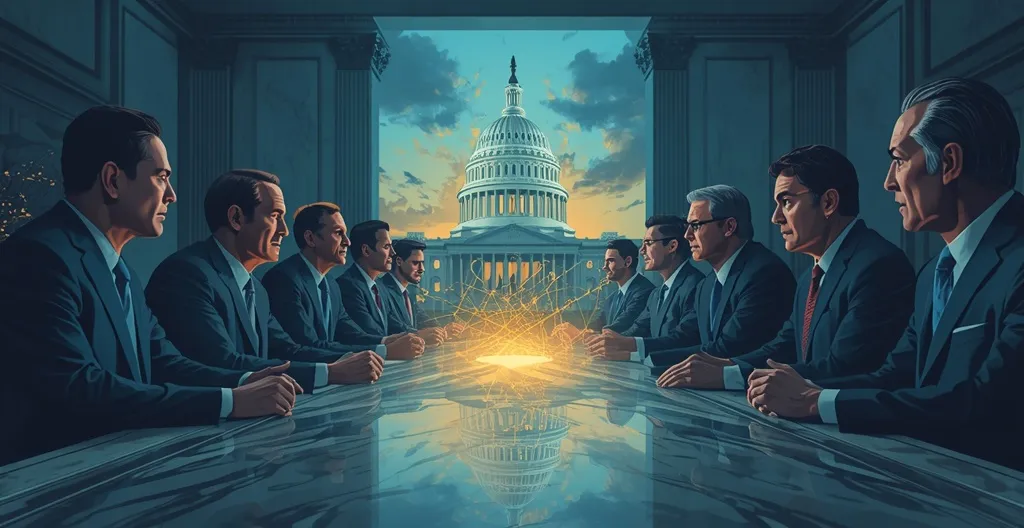
The CLARITY Act Sparks Civil War Between Banks and Crypto as supposed to give crypto a cleaner rulebook. Instead, it has turned into a pressure test for Washington, with banks, crypto firms, and Senate Democrats fighting over stablecoins, enforcement, and ethics rules as the clock ticks toward the August recess.
- Market structure is the real fight.
- Banks and crypto firms want very different outcomes.
- Ethics rules around public officials are slowing momentum.
- Passage odds have softened as the Senate runs out of time.
The CLARITY Act is not just another shiny acronym for lobbyists to toss around at cocktail events. It is a market structure bill, which means it tries to define how crypto assets are regulated, who oversees them, and how companies can operate without living in permanent legal fog.
That sounds dry. It is not. In Washington, “market structure” is where the knives come out. It decides whether a token is treated more like a security or a commodity, what disclosures issuers owe, how intermediaries must register, and which agency gets to play sheriff.
The congressional text backing the bill shows that this is more than a slogan. The legislation includes provisions for digital commodity issuers, mature blockchain systems, post-maturity reporting, intermediary registration, and SEC rulemaking. It also says, in so many words, that certain digital commodities described in the bill should not be construed as securities.
That last part matters. It is not a magic free pass for every token on the market. It is an attempt to create a transition path. A blockchain project can begin under one set of disclosure obligations, then, if it meets the bill’s maturity test, move into a different regulatory bucket with different reporting rules.
That is the kind of detail that decides whether builders stay in the U.S. or pack their bags for friendlier jurisdictions. Crypto has spent years getting whacked by uncertainty. If a team cannot tell whether it is building a product or buying itself a future lawsuit, capital gets cautious fast.
But the policy fight has been swallowed by a nastier political one.
One major snag is ethics language aimed at preventing elected officials from profiting off crypto while in office. The latest draft includes restrictions covering the president, vice president, members of Congress, and other senior federal officials. Democrats want stronger guardrails. Some Republicans worry that piling on too many restrictions could derail the bill entirely.
That is the real problem in this fight. Once crypto gets tied to self-dealing and insider access, the whole effort starts to stink like a Capitol Hill basement in July.
The Trump angle has made the ethics debate especially combustible. The bill’s opponents have used conflict-of-interest concerns as political ammunition, and some supporters want language strong enough to neutralize those attacks. Cardano founder Charles Hoskinson backed tougher ethics rules and said President Donald Trump should stay out of crypto markets while in office. He also warned that the issue could be turned into a 2026 talking point around crypto and corruption.
“As predicted, the 2026 talking points are Crypto = Trump = Corruption, and thus the left is expected to fall in line and vote against all Crypto bills.”
That is Hoskinson’s read, and while the phrasing is loaded, the political risk is real. If lawmakers think the bill looks like a vehicle for favoritism, they will happily slow-walk it into oblivion while pretending to be deeply concerned about governance.
The banking fight is easier to understand, because it is mostly about money, and banks rarely object to money when it is flowing toward them.
Banks are opposing parts of the proposal that would let stablecoin companies offer rewards on digital dollars. Their concern is simple: if consumers can hold stablecoins and earn rewards, some of that cash could move out of traditional savings accounts. Deposits are not just numbers on a screen. They are the raw material banks use to make loans and generate profit.
So yes, banks are defending their business model. That does not automatically make them right, but let’s not insult anyone’s intelligence and pretend they are suddenly riding in as neutral guardians of the common good.
Crypto firms, meanwhile, argue that banks are trying to protect an old moat and block competition before it becomes a problem. Coinbase CEO Brian Armstrong pushed back, saying banks are trying to protect their legacy model. JPMorgan CEO Jamie Dimon was far less subtle, saying: “The banks will not accept it that way.”
On the other side, Goldman Sachs CEO David Solomon voiced support for moving the bill forward. He said: “I’m very supportive of moving the Clarity Act forward, so we can get some market structure in place.” Solomon also described the goal as a “level playing field” for financial innovation.
That is not exactly cypherpunk rhetoric. But it does show how far the conversation has shifted. Even major Wall Street players are acknowledging that some version of a crypto framework is inevitable. The argument is no longer whether the market needs rules. It is whose rules, and who gets boxed out by them.
The crypto industry is still pushing hard for speed. Groups including the Blockchain Association, the Crypto Council for Innovation, and the Digital Chamber have urged lawmakers to move quickly, saying roughly 67 million Americans own digital assets. That figure is an estimate, not a census, but the political message is obvious. Crypto is no longer a niche hobby for terminally online degenerates and libertarian weirdos. It is a broad consumer and investor issue.
The Clarity Act and the future digital asset market is the kind of framing that gets institutional ears perked up, and Grayscale’s head of research, Zach Pandl, made the bull case for passage in market terms, saying:
“The bill is vital for improving liquidity and crypto markets… it can do for the industry what crypto ETFs did, unlocking the next wave of adoption.”
That comparison is useful if handled carefully. Crypto ETFs helped open the door for more mainstream exposure and broader market participation. A market structure bill could do something similar by reducing legal uncertainty, which tends to improve liquidity and make institutions less skittish.
But clarity is not automatically good. A bad rulebook is still a bad rulebook, just one printed in cleaner font.
The Senate timetable is the other problem hanging over all of this. Senate Majority Leader John Thune wants floor debate to begin before the August recess, but the bill is running short on time and support is fraying. According to reporting from Fortune, Thune said the Senate did not expect to pass the bill before it adjourns for recess. That is not a death sentence, but it is a pretty loud warning sign.
The political temperature is showing up in prediction markets too. Fortune reported Polymarket odds around 37% on Friday, down sharply from above 80% earlier in the spring. That does not mean the bill is finished. It does mean traders think the path is getting uglier, and traders are often rude but not always wrong.
Ron Hammond, head of Policy and Advocacy at Wintermute, captured the mood bluntly: “The votes are there, but the election politics are louder. The latter will dissipate after November and that’s a narrow but very possible window.”
That is probably the cleanest summary of the whole mess. The policy case exists. The politics are the drag.
Representative William Timmons put it in sports terms: “We’re on the 1-yard line, we just gotta score the touchdown.” Maybe. But in Washington, the 1-yard line is where people suddenly remember they have meetings, donors, and carefully cultivated cowardice.
The deeper issue is that the CLARITY Act has become a proxy war over the future structure of U.S. finance. Stablecoin rewards, enforcement authority, and ethics restrictions are all getting stuffed into the same legislative pressure cooker. Banks want to protect deposits. Crypto wants legitimacy. Democrats want a credible anti-corruption story. And leadership wants a bill that does not explode on contact with the news cycle.
There is also a real question about enforcement. Some lawmakers want the Department of Justice to handle it alone. Others want state attorneys general to share power. That may sound like a technical detail, but it is not. Enforcement structure determines whether the law has teeth or just ornamental fangs.
If the final version is too weak, then “clarity” becomes little more than a slogan for incumbents to keep control while pretending reform happened. If it is too heavy-handed, it could choke off innovation and hand the win to jurisdictions that are far less interested in protecting U.S. market leadership.
That is the balancing act. Crypto does need a coherent framework. Builders need to know the rules. Investors need legal certainty. And the U.S. cannot keep punting forever without making itself look unserious.
But no one should confuse “a crypto bill” with “good policy” by default. The important questions are whether the rules are fair, enforceable, and specific enough to stop abuse without freezing the market into compliance theater. Clear boundaries between the SEC and CFTC matter. So does honest treatment of stablecoins. And if lawmakers want any credibility at all, the ethics rules have to be more than decorative shameware for press releases.
The CFTC and SEC both know the fight over jurisdiction matters, which is why the agency angle has become such a big part of the broader regulatory push, including the CFTC Joins SEC to Clarify the Application of Federal framework discussions now shaping market expectations.
Industry lawyers have also been working overtime to decode the legislation, with Clarifying the CLARITY Act: What To Know About becoming required reading for anyone trying to figure out what gets covered, what gets exempted, and where the regulatory tripwires actually sit.
And yes, the delays are taking a toll. As Hopes for key crypto bill fade amid delays, Trump ethics reporting has noted, the combination of procedural drag and political baggage is turning what should have been a clean policy debate into a swampy mess.
There are also broader state-level and intra-party pressures complicating the road ahead. The Ohio Senate Race Puts CLARITY Act Crypto Regulation Bill under pressure, which is exactly the sort of local political noise that can turn a federal priority into a hostage situation.
For those watching the long game, Lummis Warns CLARITY Act Delay Could Push U.S. Crypto reform to 2030 is a reminder that “later” in Congress often means “maybe after everyone has forgotten why this mattered.”
Even so, there is still movement. The Senate Banking Committee Advances Clarity Act in Bipartisan vote showed that this is not pure fantasy. There is a coalition here. It just has to survive the usual Washington ritual of overthinking, ego, and strategic panic.
Key takeaways
- What is the CLARITY Act trying to do?
It aims to create a clearer U.S. framework for crypto market structure, including how digital assets are classified, disclosed, and supervised. - Why are banks pushing back?
They worry stablecoin rewards could pull money away from traditional deposits, which are a core source of funding for bank lending. - Why are crypto firms pushing hard for it?
They want legal certainty. Clear rules can reduce enforcement risk, attract institutions, and make it easier for the market to grow. - Why is the bill getting bogged down?
Ethics concerns tied to public officials and crypto, especially Trump-related conflict-of-interest fears, have made the politics much uglier. - What do the latest odds suggest?
Fortune reported Polymarket odds around 37%, down sharply from above 80% earlier in the spring, which points to fading momentum. - Could it still pass?
Yes, but the window is tightening. If it misses the current push, the next realistic opening may come in a later legislative session if leaders decide it is worth resurrecting.
The CLARITY Act is a reminder that crypto regulation is never just about code, custody, or compliance. It is about power, competition, and who gets to write the rules before the rest of the market catches up. That is why this fight is messy. It is also why it matters.