Circle has added upfront fee payments to CCTP Fast Transfer, letting developers quote and collect certain cross-chain USDC fees on the source network instead of quietly docking them from what the recipient receives.
- Fees paid upfront: the sender sees the cost before submitting
- Full recipient amount: fees no longer come out of the destination mint
- EVM source chain required: Solana is excluded for this specific flow
- USDC or gas token: fees can be paid in either, depending on setup
The change looks small at first glance, but it matters in practice. Under the old model, protocol fees could be deducted from the USDC minted on the destination network. Now, Circle says the fee can be collected on the source chain before the transfer runs, while the full stated amount still reaches the recipient.
That means a transfer of 100 USDC can still arrive as 100 USDC, with the fee paid separately on the originating network. For users, that means less guesswork and fewer annoying “why did they get less than I sent?” moments. For wallets and apps, it makes the payment flow easier to explain and support.
Circle says the update applies to Fast Transfer and Forwarding Service fees. In both cases, the application requests a signed quote, submits it with the source-chain burn transaction, and Circle’s system checks that the quote still matches before processing the transfer. If a bound value changes before submission, the transaction reverts.
That quote is time-limited. Circle’s documentation lists an approximate two-minute validity window on most supported networks, including Arbitrum, Avalanche, Base, Linea, OP Mainnet, Polygon PoS, Sonic, Unichain, and World Chain, while Ethereum has an estimated window of two minutes and 30 seconds.
Circle’s Quote API bundles the relevant fees into a single signed quote. Applications send the transfer amount, source and destination domain identifiers, the payment token, and the fees they want priced. The API can handle a PRE_FINALITY request for the Fast Transfer charge, a FORWARD request for the Forwarding Service charge, or both in the same call.
The result is a cleaner checkout-style flow. The app can show the user the transfer amount, the fee, and the final amount before anything is approved. That’s not flashy, but it is exactly the kind of boring improvement crypto badly needs.
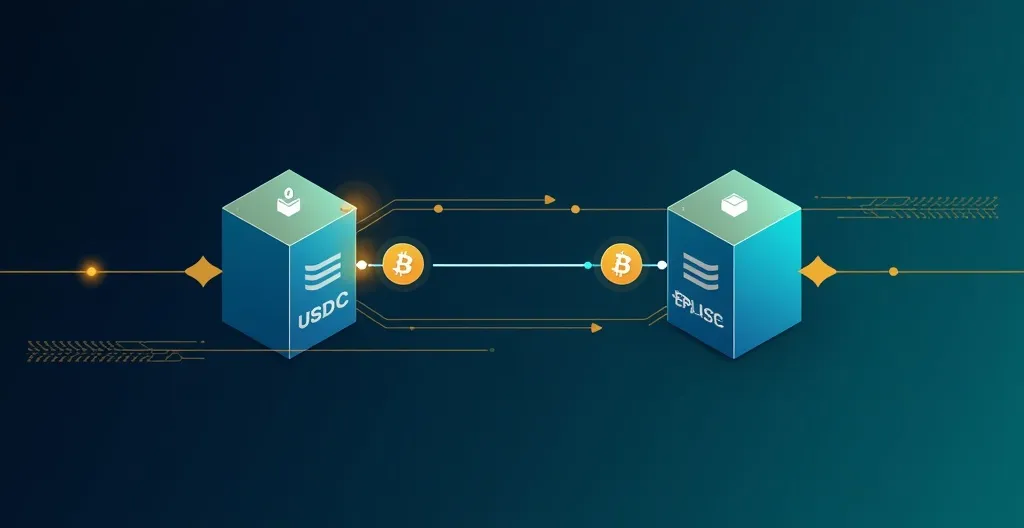
CCTP itself moves native USDC through a burn-and-mint system. USDC is burned on the source chain, Circle verifies the transfer, and then the full amount is minted on the destination chain. That is very different from wrapped-token bridge designs, which can add their own mess of assumptions, liquidity issues, and attack surfaces.
To be clear, CCTP is not some trustless Bitcoin-style miracle. It is an issuer-controlled system, and Circle is upfront about operating the infrastructure across every connected network. That is the tradeoff. Cleaner UX and less bridge chaos in exchange for relying on Circle’s issuance and verification stack. Convenient? Yes. Decentralized in the Bitcoin sense? Not even close.
The new prepaid-fee flow also gives developers some flexibility. Fees can be paid in USDC or in the source chain’s native gas token. Circle says the native-token option is the default and may suit wallets and apps that already hold gas assets on the originating chain. Paying in USDC keeps the cost denominated in dollars, which is easier for users to understand than watching a gas token wobble around like it just drank three espressos.
For Forwarding Service transactions, Circle’s updated contract can automatically create the required cctp-forward hook when no custom hook data is provided. If an app does use custom instructions, it has to submit the same hook data when requesting the signed quote and when sending the transaction. That binding keeps the quote locked to the exact transfer parameters instead of turning it into a free-for-all.
There is one hard limit that matters right now: upfront fee quotes require an EVM-compatible source chain. Solana cannot be the source network for this prepaid-fee transaction flow because it is not EVM-compatible. That does not mean Solana is shut out of Circle’s broader ecosystem, but it does mean this particular source-side fee model is not available there yet.
The bigger picture is that Circle keeps tightening the screws on its own cross-chain stack. In August, Circle launched CCTP on X Layer, taking the protocol to 26 blockchains while native USDC was available across 36 networks. In July, Circle also connected Gateway with Fireblocks. Put together, the message is obvious: Circle is pushing to make moving USDC across chains more native, more predictable, and more turnkey for developers.
Circle also frames its forwarding stack as a way to reduce operational cost and risk while improving end-to-end speed. The company says removing attestation fetching can reduce transfer time by 50% to 200%, though that figure is Circle’s own claim and should be read as such. The important point is less about the marketing number and more about the direction: less manual orchestration, fewer moving parts, and fewer excuses for a broken user experience.
That said, the convenience comes with a centralization tradeoff that should not be hand-waved away. CCTP is cleaner than many bridge setups and avoids the usual wrapped-asset circus, but it also places more of the cross-chain experience under Circle’s control. For some users and developers, that is a fair price for reliability. For others, it is exactly the kind of dependency they want to avoid.
Still, the practical win is hard to ignore. A sender can see the fee before confirming. The recipient gets the full intended amount. The app gets a signed, time-limited quote it can verify onchain. In crypto, that qualifies as rare and useful progress.
Key questions and takeaways
-
What changed in Circle’s CCTP fee flow?
Fees can now be collected on the source chain upfront instead of being deducted from the amount minted on the destination network. That makes the final transfer amount more predictable. -
Why does this matter for users?
It removes the surprise of sending one amount and seeing a smaller amount arrive. The sender can see the fee and the recipient’s exact amount before approving the transfer. -
Can fees be paid in USDC?
Yes. Circle says fees can be paid in USDC or in the source chain’s native gas token, depending on the setup and the app’s request. -
Which chains can use upfront-fee quoting?
The source chain must be EVM-compatible. That means non-EVM chains like Solana are not eligible for this specific prepaid-fee flow right now. -
Is CCTP a wrapped-token bridge?
No. CCTP (Cross-Chain Transfer Protocol) uses native USDC in a burn-and-mint system. That avoids the wrapped-asset model, but it still depends on Circle’s infrastructure and trust assumptions. -
What is the tradeoff?
The payoff is cleaner pricing and better UX. The cost is more reliance on Circle as the issuer and operator of the cross-chain plumbing.
Further reading
A few related angles on Circle’s cross-chain push and stablecoin strategy: