
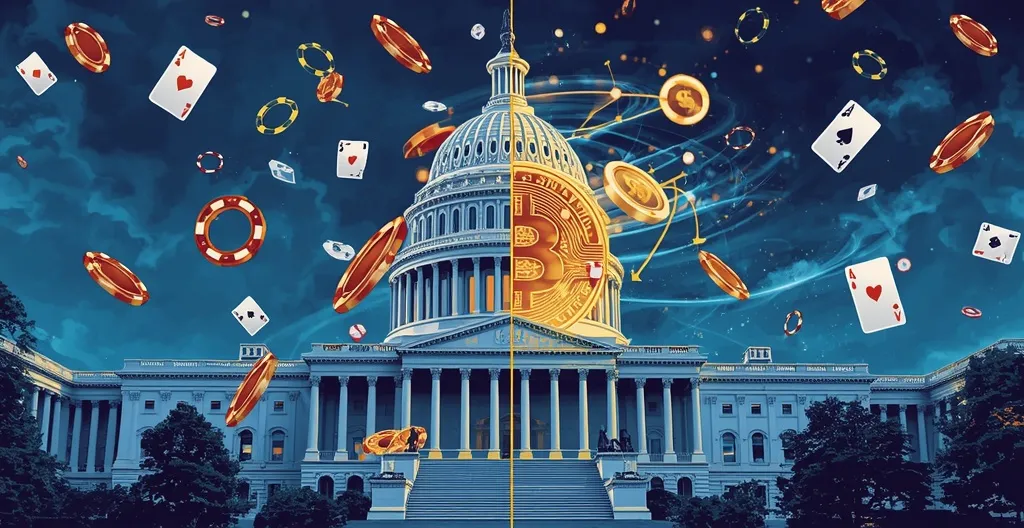
Congress is weighing two tax fixes that have been kicked down the road for years. One would stop gamblers from being taxed on money they never really kept. The other tries to drag crypto tax law out of the stone age.
- Gambling relief: The FULL HOUSE Act would restore full loss deductibility.
- Crypto overhaul: Ways and Means is advancing rules for mining, staking, wash sales, and constructive sales.
- Shared pressure point: Rep. Steven Horsford is central to the gambling push and influential on crypto tax talks.
The gambling fix is the cleaner fight, and also the easier one to explain without a tax law migraine.
Starting January 1, 2026, gamblers can deduct only 90% of their losses instead of 100%. That sounds like a tiny haircut until you do the math. If someone wins $100, 000 and loses $100, 000, the old rule allowed the full loss to be deducted. Under the 90% cap, only $90, 000 is deductible, which leaves the person taxed as if they made $10, 000.
That is what tax professionals call phantom income: taxable income that exists on paper, not in actual profit. In plain English, the government is reaching into a pocket that is empty.
H.R. 6985, the FULL HOUSE Act, would reverse that cap. The acronym stands for Facilitating Useful Loss Limitations to Help Our Unique Service Economy Act. Yes, Congress really does enjoy turning a straightforward fix into a bureaucratic crossword puzzle.
Rep. Steven Horsford, a Democrat from Nevada, and Rep. Max Miller, a Republican from Ohio, introduced the bill in January 2026. A Senate companion was also introduced by Catherine Cortez Masto, a Democrat from Nevada, and Ted Cruz, a Republican from Texas.
The politics here are not subtle. Nevada’s gaming industry is not some fringe hobby; it is a major part of the state’s economy. Horsford has argued that the deduction cap hits gaming, tourism, and the broader activity that depends on both. When Congress tinkers with wagering taxes, it is not just talking about blackjack tables and sports bets. It is poking a pillar of a state economy and acting surprised when people notice.
The crypto side is more technical, but no less consequential. The House Ways and Means Committee is also moving a broader digital-asset tax package that includes mining, staking, wash-sale, constructive-sale, charitable-donation, and disclosure provisions.
The centerpiece is H.R. 9175, the Tax Clarity for Mining and Staking Act. The committee says the measure would clarify how newly minted digital assets are treated and allow taxpayers to elect treatment similar to self-created property. That is a more precise framing than “tax deferred until sale, ” which is too loose for a rule that affects when income is recognized and how it is accounted for.
For readers who do not spend their weekends in blockchain plumbing: mining is the process of using computing power to validate transactions and secure a proof-of-work network like Bitcoin. Staking is different. It means locking up crypto on a proof-of-stake network to help secure it and earn rewards.
Those rewards create a stubborn tax problem. Under the IRS position cited in the notes, Revenue Ruling 2023-14 taxes miners when the tokens land in their wallet. That can trigger tax before the asset is sold and before the holder has cash to pay the bill. Try paying your taxes with unsold crypto and you quickly learn why people call this setup absurd.
There is a real policy question underneath the noise: when does value become income? Crypto rewards do not fit neatly into tax rules built around wages, dividends, and other older forms of income. That does not mean miners and stakers should get a free pass. It does mean the current system is clunky enough to punish honest users while leaving plenty of room for confusion.
The package also includes H.R. 9172, which would extend wash-sale and constructive-sale rules to actively traded digital assets.
Wash-sale rules are familiar in traditional securities markets. They stop someone from selling an asset at a loss and immediately buying it back just to claim the deduction while staying in the same position. Crypto traders have long benefited from the fact that those rules generally do not apply to digital assets in the same way they do to stocks.
Constructive-sale rules are another anti-abuse tool. They can trigger tax when someone effectively locks in a gain without formally selling. In other words, you do not get to dress up a sale in a fake mustache and hope the IRS does not notice.
The Joint Committee on Taxation estimates H.R. 9172 would raise roughly $2.07 billion between 2026 and 2036. That matters because it shows the bill is not just about tidy tax administration. It is also a revenue play, which is Washington’s way of saying, “We found the money, now let’s make the rules look principled.”
One thing to watch closely: the mining-and-staking piece appears politically more fragile than the anti-abuse provisions. The notes say it may not survive to a final vote, but that has not been confirmed in the materials provided here. If it does get stripped out, the package becomes easier to defend as a crackdown on tax gamesmanship and harder to attack as a gift to the crypto industry.
That tension is the heart of the whole debate. Congress says it wants “clarity, ” but clarity can mean two very different things. Sometimes it means less ambiguity for ordinary users. Sometimes it means lawmakers and the IRS now have cleaner lines to tax, audit, and punish people with.
Rep. Steven Horsford sits in the middle of this in a way few lawmakers do. He is a co-sponsor of the gambling bill and described as one of the most vocal crypto backers among Ways and Means Democrats, with real influence on where the package goes next. That does not mean the gambling and crypto fights are formally linked. It does mean one lawmaker has become a useful bridge between two very different tax headaches.
The overlap is mostly political, not legislative. The gambling bill is about stopping a bad rule that taxes phantom gains. The crypto package is about sorting out how digital assets should be taxed, while also closing the usual loopholes traders love to exploit. Same committee, same deadline pressure, different messes.
The timing matters too. Lawmakers are moving with the clock ticking toward the midterm elections, which is exactly when Congress tends to discover a sudden passion for unfinished business. Tax bills are hard enough to move when everyone is calm. They get uglier when campaigns start eating the calendar.
- What is “phantom income”?
It is income that exists for tax purposes but not as actual net profit. Here, it means gamblers can owe tax even if they broke even overall. - What would the FULL HOUSE Act do?
It would restore full deductibility of gambling losses instead of limiting deductions to 90%, which would fix the phantom-income problem. - Why does crypto mining need tax clarity?
Mining creates new tokens, and the IRS position cited here treats those tokens as taxable when received. That can create a cash-flow problem if the tokens have not been sold yet. - What do wash-sale rules do?
They block traders from selling at a loss and immediately buying the same or a similar asset back just to manufacture a tax break. - What is the point of adding constructive-sale rules to crypto?
The goal is to tax gains when someone has effectively locked them in, even if there is no formal sale on paper.
There is a decent argument that both efforts are overdue. Gambling taxes should not punish people for breaking even. Crypto tax law should not stay half-baked forever while the industry pretends ambiguity is a business model. But there is also a harder truth: whenever Congress says it is fixing “fairness” or “clarity, ” it often ends up writing rules that are sharper, stricter, and easier to enforce than the old ones.
That is why this week matters. The committee vote will not settle everything, and it is nowhere near final passage. But it will show whether lawmakers are serious about fixing a broken gambling deduction, and whether they can modernize crypto taxation without turning it into another bloated, half-answered mess.
Further reading
A few relevant resources on the tax fight around gambling and digital assets:
- Congress Votes This Week on Gamblings Phantom Income Tax
- Legislation Proposes Clear Tax Rules for Digital Assets
- Archived text on laundering, drugs, and prosecution
- Why Congress Must Urgently Restore the Gambling Loss Deduction
- How Should Cryptocurrency Be Taxed?
- House Ways & Means Committee Releases Draft Crypto Tax Legislation
- U.S. Crypto Groups Back Bill to Delay Taxes on Mining and Staking Rewards
- South Korea Crypto Tax Revolt Hits 52, 900 Signatures