
Bitcoin shrugs off the macro hit while Pepeto leans hard on presale hype
Hot U.S. inflation data, shifting Fed expectations, and an ECB rate hike did not knock Bitcoin off its feet. That resilience is real. So is the circus around speculative presales trying to pass themselves off as the next big thing.
- Bitcoin held up after hotter producer price data and tighter rate expectations.
- Markets priced in more Fed uncertainty, with CME FedWatch showing about 72% odds tied to the September 16 decision.
- Pepeto is being marketed as a high-upside presale, but that pitch comes with classic meme-coin risk.
- BNB pulled back, sitting between established large-cap credibility and higher-risk speculation.
August producer prices came in at 5.4%, according to the BLS. That matters because the Producer Price Index tracks wholesale inflation, and hotter readings can reinforce the idea that the Fed may need to keep policy tighter for longer. In plain English, traders hoping for easier money did not get the reassurance they wanted.
CME FedWatch put the odds of a September 16 hike at about 72%, and CoinDesk reported traders trimming bullish bets before the data landed. The European Central Bank also raised rates by a quarter point, adding to the mood of “rates stay high, deal with it.” Crypto likes liquidity. Tight policy is the opposite of a party invitation.
That is the part worth paying attention to. Bloomberg reported Bitcoin falling as much as 3.5% on September 4 on the jobs report, but the market later stabilized. CoinGecko showed Bitcoin trading at $79, 126, up 2.69% in 24 hours, with the total crypto market at $2.7 trillion. ETH slipped to about $2, 465, while the Fear and Greed Index moved from 69 to 56, a reminder that sentiment can cool quickly when macro data gets ugly.
Bitcoin was also still trading more than 20% above its summer low near $63, 000. That does not mean the coast is clear, but it does show the market is not treating a hotter inflation print like a death sentence. Support is being watched near $76, 000, with resistance around $80, 000 to $82, 000. A clean close above $82, 000 would open the door toward $88, 000, at least in the eyes of traders who live and die by chart levels.
Technical levels are useful because they reflect where money is actually clustering. They are not prophecy, though. Markets love to punish certainty. The same crowd that swears a level “has to hold” is often the first to post the chart in flames when it doesn’t.
Options traders have also been loading the $88, 000 strike for September, according to Coincall. That does not guarantee anything; it simply shows where some of the positioning is leaning ahead of the Fed decision. In derivatives markets, positioning can be a map of conviction, hedging, or pure anxiety with a spreadsheet attached.
There is also a more basic reason Bitcoin looks sturdier than the promo crowd gives it credit for: size. Bitcoin’s market cap is around $1.54 trillion, so it is not going to double on a random burst of attention. That annoys the moonboys, but it is also why BTC tends to survive ugly stretches better than smaller tokens. Big, liquid assets do not offer the same lottery-ticket upside, but they also do a much better job of not blowing themselves up.
That is exactly the gap Pepeto is trying to exploit.
Pepeto’s marketing is pushing the project as a “best crypto to buy now” play ahead of the September 16 decision. It is described as a meme coin presale with an exchange, bridge, and scanner already running, plus staking advertised at 163% APY, compounded daily. The project is said to have raised $10.9 million and is priced at $0.0000001894.
That sounds exciting if you are shopping for lottery tickets. It should sound risky if you are doing actual due diligence.
Presales are notorious for front-loading the sales pitch and leaving the hard questions for later, if they are answered at all. A bridge is a tool that moves tokens across blockchains. A scanner, in this context, is a feature meant to review projects before users interact with them. Fine. Useful maybe. But a shiny feature list does not prove a token has durable value, healthy economics, or real demand once the promo wave passes.
The same goes for the 163% APY. Annual percentage yield is the yearly return rate, including compounding, but in crypto those numbers are often tied to token emissions or reward schemes that can be heavily diluted. If the token price falls hard enough, a huge APY can become decoration. A very expensive decoration, but still decoration.
Pepeto also claims its code was cleared by SolidProof. That may sound reassuring, but an audit is not the same thing as a guarantee. Audits can reduce obvious technical risk, but they do not erase market risk, tokenomics risk, or the fact that meme coins can go from “viral” to “forgotten” in about the time it takes a group chat to discover a new distraction.
There is also the vague claim that the project is backed by the “Pepe cofounder behind a $7 billion token.” Vague is doing a lot of work there. Unnamed prestige claims are not the same as independently verifiable proof, and they should be treated with the caution they deserve. If a pitch needs a fog machine, that usually means the fundamentals are still backstage.
The rumor of a future Binance listing fits the same pattern. Maybe it happens, maybe it doesn’t. Unless Binance says so, it is speculation, not a fact, not a roadmap milestone, and definitely not a reason to confuse marketing with certainty. A lot of tokens are “one listing away” right up until they are not.
That does not mean Pepeto cannot run. Meme coins can move violently when sentiment, liquidity, and attention line up. They can also implode just as fast. That volatility is the whole point for some traders. It is also how a lot of people end up buying the top of a narrative and then pretending they were “early.”
BNB sits in a more grounded middle zone. Bybit showed it at $733 on September 6 before it slipped to around $720, a roughly 5% pullback. Support near $680 reportedly held, and Changelly marked $770 as a September area to watch. BNB’s market cap is near $97 billion, which puts it well below Bitcoin but far above the true microcap gamble zone.
BNB Chain’s roadmap is said to aim at doubling mainnet throughput in the second half of 2026. That kind of target matters only if execution follows. Crypto roadmaps are cheap. Shipped upgrades are the part that counts. Plenty of projects can draft a slick future. Fewer can build it without tripping over their own promises.
BNB is interesting because it offers a different kind of upside than Bitcoin or a fresh presale. It has a real ecosystem, real liquidity, and real adoption, but it also carries exchange-linked and regulatory baggage that BTC largely sidesteps. It is not as politically neutral as Bitcoin and nowhere near as speculative as a tiny meme-coin launch. That makes it less dramatic, which is usually a good sign when the alternatives are dressed-up roulette wheels.
The bigger question is whether the market has already priced in the Fed noise. If Bitcoin can hold near current levels while macro data turns less friendly, that can be read as strength. It can also be read as complacency before another sharp move. Markets rarely bother to reward the obvious thesis on cue.
Key questions and takeaways
-
Did Bitcoin shrug off the macro shock?
Mostly, yes. Hotter inflation data and a higher rate-hike odds backdrop did not break Bitcoin’s structure, though the market is still exposed to more volatility if policy expectations shift again. -
What levels matter for Bitcoin now?
Traders are watching $76, 000 as support and $80, 000 to $82, 000 as resistance. A strong close above $82, 000 would put $88, 000 back in view, but that is a trading setup, not a guarantee. -
Why is Pepeto getting so much attention?
Because its marketing is pitching a small-cap presale with live tools, staking, and outsized upside potential. That same pitch is also why it carries heavy risk and deserves skepticism. -
Is a 163% APY a reason to buy?
Not on its own. In crypto, big APYs often come with dilution, token emissions, or reward mechanics that can collapse in value if price and demand do not keep up. -
Does an audit make Pepeto safe?
No. A code audit can help spot technical problems, but it does not validate the token’s economics, leadership claims, or future market performance. -
How does BNB compare with Bitcoin and Pepeto?
BNB sits between the two: more established and liquid than a presale, but more exposed to ecosystem and regulatory risk than Bitcoin. It has more upside than BTC in some scenarios, but less than a tiny speculative token if the hype train catches fire.
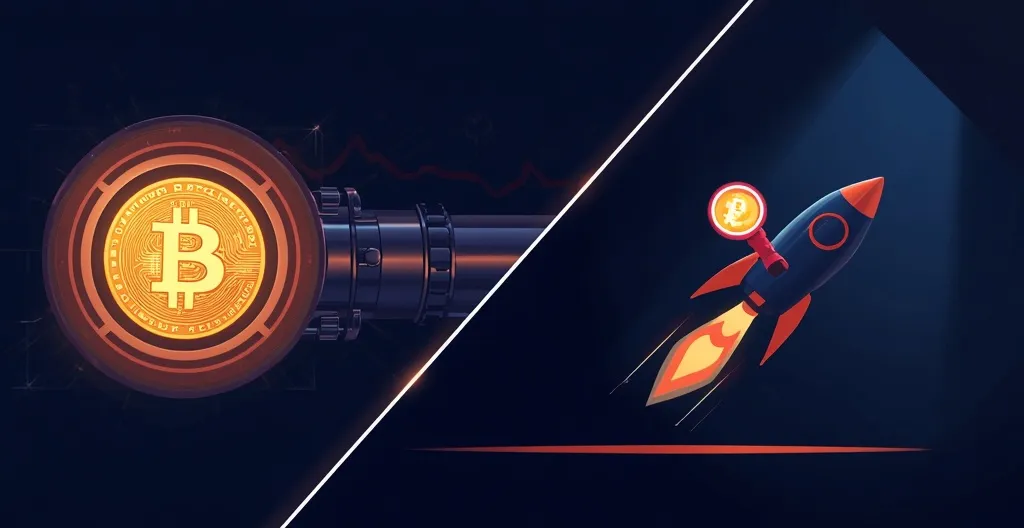
Bitcoin is doing what Bitcoin tends to do when macro gets messy: it is holding the line better than the hype crowd expected. Pepeto, by contrast, is doing what meme-coin presales usually do: stacking buzzwords, yields, and future-listing dreams on top of a very high-risk setup.
One looks like a battle-tested monetary asset that still has room to surprise. The other looks like a speculative bet wrapped in promotional glitter. In crypto, that distinction still matters, a lot.
Further reading
A few extra resources on Bitcoin pricing, market context, and the economics behind it: